Postdoctoral Research Overview
Biomaterials are natural or synthetic materials engineered for medical applications to support, enhance, or replace damaged tissues or biological functions. Among them, silk fibroin stands out as a versatile biopolymer with exceptional biocompatibility, biodegradability, and mechanical tunability. Derived from Bombyx mori silkworm cocoons, silk can be processed into diverse formats, including films, sponges, hydrogels, and coatings, making it suitable for applications in drug delivery, tissue engineering, and biosensing. The ability to precisely control silk’s structure and stiffness allows it to mimic physiological environments or direct cellular responses. These attributes make silk an ideal platform for designing responsive biomaterials that evolve with their biological surroundings.
Mariah started her Postdoc in Dr. Kaplan’s Lab in June of 2024. She joined as a Tufts IRACDA Fellow. Her current research focuses on silk fibroin–based biomaterials for drug delivery, tissue engineering, and fibrosis modeling. In 2025, she received the Natalie V. Zucker Award for her work on pulmonary fibrosis. Mariah also leads and contributes to several interdisciplinary collaborations, including studies with Columbia University through the Tissue Engineering Resource Center (TERC) and projects with the Air Force Research Laboratory (AFRL). Additionally, she has mentored students on the design of long-acting therapeutics and the integration of lipid nanoparticles with silk materials to develop hybrid delivery systems.
Fibrosis Modeling
Fibrosis is the pathological buildup of scar tissue that arises from chronic injury or inflammation. When normal wound healing becomes dysregulated, excessive extracellular matrix deposition leads to tissue stiffening and loss of function. Fibrosis contributes to many chronic diseases, including pulmonary, hepatic, and cardiac disorders, and remains a major unmet clinical challenge. The goal of Mariah’s work is to create dynamic silk-based models of fibrosis that capture how tissue stiffness evolves over time, enabling a better understanding of disease progression and therapeutic response.
Two manuscripts on fibrosis modeling are currently in preparation, with Mariah leading the pulmonary fibrosis research arm (pre-printed and in revison) and contributing to the broader development of dynamic silk-based disease models.
First Author Publication
Bridging Silk Biomaterials and Lipid Nanoparticles
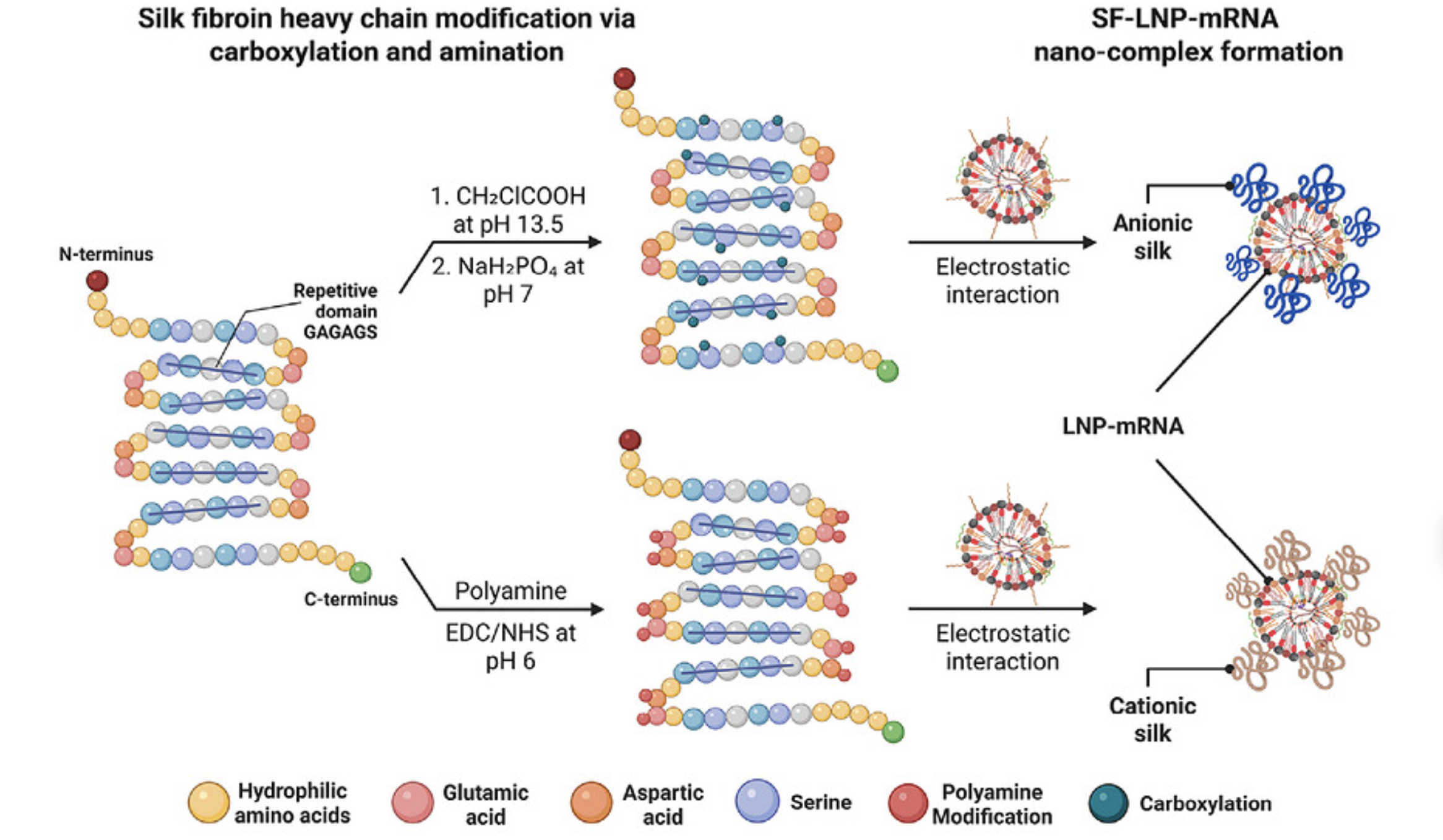
Lipid nanoparticles (LNPs) are effective at delivering mRNA to the liver, lung, and spleen, but reaching other tissues remains a major challenge for the field. Silk fibroin, a biocompatible and chemically tunable protein, offers new ways to engineer LNPs and to test them before they ever reach animal studies. During her postdoc, Mariah had the opportunity to combine her Ph.D. training in LNP delivery with her lab's expertise in silk fibroin to pursue this new research direction. Mariah mentored students and conducted experiments on coating LNPs with silk to redirect them to new tissues and building silk-based tissue models that predict how well an LNP crosses barriers like the blood-brain barrier.
Publications
Long-Acting Therapeutics
Silk can be thermally molded into dense, plastic-like materials that release drugs or degrade on a controlled timeline. Mariah mentored Dr. Kareen Fajardo Cortes on two projects exploring this platform: molding drug-loaded silk reservoirs that release chemotherapy drugs over time, and embedding enzymes directly into silk plastics to trigger degradation on demand. Both projects show that silk protects sensitive drugs and enzymes from the heat used to process it, establishing silk plastics as a potential platform for long-acting, shelf-stable drug delivery.
Publications
Optical Sensing Silk Microneedles
The manuscript has been submitted; more details will be posted when it is accepted.
Silk-Hydrogel Synthesis and Characterization
Mariah develops and characterizes silk fibroin hydrogels with tunable mechanical and biochemical properties. By modifying silk chemistry and crosslinking conditions, these hydrogels can be precisely engineered to control stiffness, degradation rate, and molecular interactions. Her work integrates synthesis, rheological and mechanical testing, and biochemical functionalization to create next-generation silk materials for drug delivery and regenerative medicine applications. Mariah’s publication on this is in preparation, and she plans to submit it before leaving for her Fulbright.