The Arral Age and Drug Delivery Lab is on the Faculty Market
Fall 2026
Mariah is on the faculty market for Fall 2026 and is incredibly excited to present the plans for her future research group. The Arral Age and Drug Delivery Lab will work to create and understand drug delivery for every age and stage.
My lab will study how age and sex change the way drug delivery systems work in the body. Most therapies are designed and tested in young, healthy adults, even though they're often meant for infants, older adults, and everyone in between. My lab will use lipid nanoparticles and silk-based biomaterials to figure out why the same treatment can work differently depending on who receives it, with the goal of designing therapies that work well for everyone.
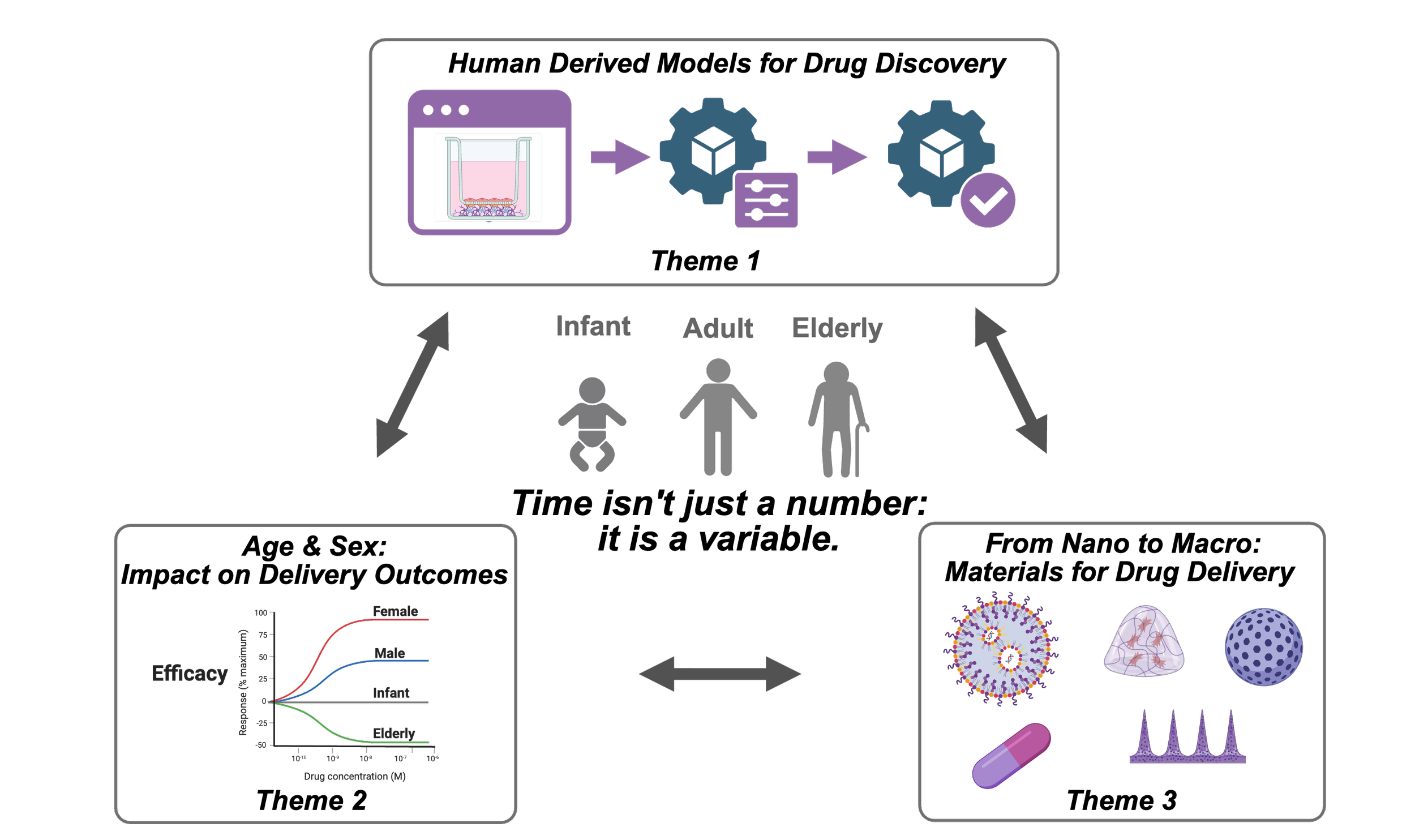
Addressing the data gap that is needed for AI modeling
A gap this work addresses: AI models are increasingly used to predict how a drug delivery system will perform, but those predictions are only as good as the data behind them. Without data on how new materials behave across different ages and sexes, AI can't reliably predict outcomes for the full population. These themes are built to generate that missing data.
Theme 1: Human-Derived Models for Drug Discovery
Lab tests need to reflect real, diverse bodies, not just young and healthy ones.
This theme builds modular testing platforms in three parts. First, we study the protein corona, a layer of proteins that coats a nanoparticle as soon as it enters the body and determines how the immune system recognizes and clears it. This coating could change depending on where in the body a therapy is delivered and the individual's disease state or sex. Second, we test therapies against diverse cell systems; for example, immune cells from diverse (young, old, male, female) donor populations to reveal how age and sex change cellular uptake. Third, we build lab-grown tissue models, starting with fibrosis, using silk-based materials that mimic how tissue stiffens and changes with age and disease. Theme 1 is positioned to launch quickly, with the fewest barriers to accessing materials and equipment.
Theme 2: How Age and Sex Shape Drug Delivery Outcomes
The same drug can work differently depending on who receives it, and we're mapping out why.
While Theme 1 builds cell and tissue models, Theme 2 moves into in vivo studies, where the full picture of how a therapy travels through the body and interacts with the immune system can be captured. Using in vivo models of aging, sex, and inflammation, my lab studies two types of therapies: nanoparticles and gel-based implants. One project focuses on mRNA LNPs, tracing how age, sex, and inflammation change where and how well a therapeutic reaches its target, with the goal of designing formulations that work equally well for everyone. The other focuses on hydrogel-based treatments, examining how aging and inflammation shift the balance between healthy tissue repair and scarring, to engineer materials that promote healing in aged or inflamed tissue specifically.
Theme 3: New Materials, From Nanoparticles to Tissue Scaffolds
Combining the precision of nanoparticles with the durability of biomaterials opens new options for long-acting therapies and more.
This theme is set up to be high-risk, high-reward for the AADD Lab. My lab will combine existing platforms and invent entirely new ones, generating new intellectual property along the way. It connects directly back to the other two themes, supplying new materials for Theme 1's testing platforms and new carriers for Theme 2's in vivo studies.